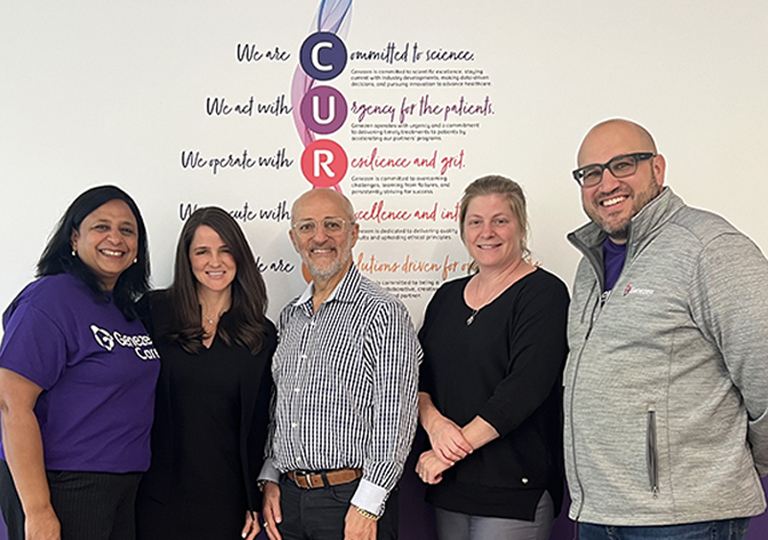
At Genezen, our mission has always been rooted in a singular goal—serving patients. That ethos came to life during a recent panel discussion led by Genezen’s Chief Technical and Commercial Officer Dr. Susan D’Costa, where we were honored to join forces with some of our rare disease partners to speak about the challenges, opportunities, and critical collaborations that power the development of life-changing gene therapies.
The conversation, driven by the voices of scientists, advocates, and parents, spotlighted how every step we take as a viral vector CDMO impacts not only the progress of science—but the lives of individuals and families who are often in a race against time.
Whether it’s rolling up our sleeves to hand-deliver devices to keep a clinical timeline on track or building new manufacturing processes to meet accelerated regulatory milestones, Genezen is proud to stand beside our partners with the mindset of, “let’s solve this together.”
Powering Progress Through Partnership
Our panelists, Michelle Krueger, CEO and co-founder for Elly’s Team, Dr. Kathrin Meyer, Chief Scientific Officer and Head of Research & Development at Alcyone Therapeutics, and Dr. Amin Abujoub, Chief Technical Operations Officer at uniQure shared powerful reflections on what true partnership looks like—something that’s more than a business transaction. At Genezen, partnership means embedded collaboration, where our team becomes an extension of our partners’ teams. It’s about more than facilities or timelines—it’s about trust, responsiveness, and shared responsibility.
“Anytime we hit a roadblock, there were multiple people raising their hands to solve it or get us through it,” said Michelle, parent and advocate co-leading Elly’s Team, a foundation with the singular goal of translating medical research to treatment in record time. She recounted a critical moment where her team needed devices in Indianapolis to test compatibility with the treatment product for her daughter, Elly, who was diagnosed with an IRF2BPL (Interferon regulatory factor 2 binding protein-like) gene mutation which is known to cause a neurodegenerative disease called Neurodevelopmental Disorder with Regression, Abnormal Movements, Loss of Speech, and Seizures (NEDAMSS). “It might seem so minor but really getting Elly that treatment even one month earlier might save her life. So, it matters.”
Michelle shares how the partnership with Genezen and Alcyone made an impact on the speed to Elly’s dosing:
Dr. Meyer added, “Genezen certainly beat all the timelines when it came to contracting on that last piece,” referring to the urgency and precision required in conducting a compatibility study. In a world where delays could mean lost therapeutic windows, responsiveness matters.
Dr. Abujoub summed it up: “How are we really going to do all the work that usually takes 12 months, in 12 weeks or less… I don’t think any other partner could have done that.”
Dr. Abujoub expanded further on what it means to partner with Genezen to bring uniQure’s program through to BLA filing:
That’s the spirit we aim to bring into every collaboration—whether the goal is a first-in-human dose or commercial readiness.
Impacting Patients at Every Scale
The need for gene therapy is universal—but the path to development is often especially difficult in the rare and ultra-rare disease space. These programs are frequently parent- or patient-led, fueled by urgency and limited resources. Genezen is deeply committed to making sure those programs receive the same level of rigor, expertise, and support as the largest commercial launches.
As Steve Favaloro, Genezen’s CEO, shared during the panel, “Our vision for the business is to serve parent-founded foundations all the way to commercial products. We are in awe of what they do… we have an army of 270 people today and growing at Genezen, who care deeply about what we’re doing to serve our partners and serve patients.”
Our team has been privileged to work with foundations focused on single patients—sometimes called “N-of-1” programs—and help scale their work into pathways that can benefit others with similar diagnoses. That’s what makes our role so meaningful: we’re not just building vectors, we’re building bridges between discovery and access.”
But as the panel emphasized, access is still a significant hurdle.
“There’s a lot of work that we all need to do,” said Dr. Abujoub, “to educate society about gene therapy. Gene therapy is an expensive drug… But I don’t think society yet is ready for the treatment option. There is a lot of need of involvement from everyone – beyond the science – to get your neighbor and the people you talk to, to understand the criticality of gene therapy and how complex it is to get it to the patient that needs it. So, we need for people to start advocating more and more to make the treatment an option – we are not making drugs to make people just get better, we want to treat them, we want to cure them.”
Part of our responsibility, as an industry, is to help reshape that readiness—through education, advocacy, and stories that humanize the science.
Looking to the Future: Innovation that Saves Lives
The conversation also turned to what’s next—how advances in science and manufacturing are poised to make gene therapy more effective, more accessible, and more sustainable.
Dr. Meyer commented on the advancements in gene therapy that she is excited about:
Innovation is at the heart of what we do at Genezen—developing solutions that ensure therapies not only work in the lab but get to the right cells in the right tissue at the right time. We are honored to partner with and support organizations who are going the extra mile to achieve new methods of delivery.
A powerful example shared on the panel involved Elly, the first patient to receive an optimized delivery protocol based on a “digital twin” of her nervous system. “We made a digital twin of Elly’s nervous system and really studied and optimized the protocol for the delivery to give her the best chance of having the most even delivery and deliver the most drug to the brain,” Dr. Meyer explained.
From novel capsids to sophisticated delivery techniques, from analytical innovations to scalable manufacturing, these advancements are helping push the field forward faster and smarter, while reducing cost and increasing access.
A Mission Beyond the Lab
For some of the panelists, the work doesn’t end with a successful dose—it expands into advocacy and system-level change.
Michelle spoke about the need to pave a path for others. “My purpose now is not just for Elly,” she said, “It’s for all of the other kids who have her disease…that can’t just pick up the phone and pull together a team and raise $2 million and treat their kid in 10 months. I’m very motivated to create a path where other people can do this, too.”
She described a future we’re all working toward. “In the future when someone is sitting in the hospital, and they get this diagnosis, their doctor is not telling them there’s no treatment. They’re saying, ‘Hey, we have a gene therapy. It’s going to be here tomorrow. And your two-month-old baby is going to live.’ That’s the future.”
Why We Come to Work Every Day
At Genezen, we know that the science we’re helping to advance is only one piece of a much larger, deeply human story. Every vector we manufacture carries hope, urgency, and the determination of families, researchers, and advocates who believe there is a better future waiting on the other side.
As Dr. D’Costa said simply and poignantly during the panel: “This is why we come to work every day.”
We come to work for the parents who won’t stop fighting. For the children waiting for treatment. For the researchers pushing boundaries. And for the partners who trust us to help deliver on life-saving missions.
We’re proud to play a role in transforming rare disease therapy from possibility to reality—and we’re just getting started.
To learn more about Genezen’s work in rare diseases and how we collaborate with partners of all sizes, visit genezen.com.